Best Espresso drinks from Italy

Getting ready for our trip to Italy, I have been looking around for what is popular both in beans and drinks in the different areas of Italy. I am looking for what would be thought of Italian coffee versus International coffee. The skill of brewing a quality cup of coffee versus what you can add to your cup to change it to fit a mood or environment. Tough work, someone has to do it!

I actually found a magazine article that had the same interest… I’m not alone I see. Their concern was regarding what you can order in Italy that is reproducible elsewhere.

They suggested three drinks:

  • Corretto – This is the drink of choice for cold days and hardy men. It is a classic Italian espresso which is ‘corrected’ with a spirit shot. Patrons usually tell the barista what they want in their corretto, but the ever popular grappa is the barista’s default.
  • Marocchino – This drink has an unusual hue. A blend of espresso, frothed milk and cocoa powder. The espresso is made and poured in a demitasse-size glass with a metal handle. Then cocoa is sprinkled on it.
  • Caffé latte – The basis of the Latte. Unlike the British and American versions, which call for 1/3 coffee and 2/3 milk and foam, the Italian one requires 25ml espresso and enough milk to fill a 160ml glass. The milk is rigorously hot but not frothy, and is poured on the cup on top of the coffee. Caffé latte, which is essentially a foam-less cappuccino.

I would recommend you taking a look at the full article if you wish to make these at home, the author did a nice job of outlining temps and quantities for each drink to best match it to the authentic Italian served version.

They do wrap is up with a few other interesting coffee drinks served in Italian bars

Doppio—that’s simply a double espresso

Ristretto—an espresso with less water than usual

Lungo—an espresso with more water than usual

Caffé con panna—an espresso topped by whipped cream

Freddo—iced coffee made with espresso

Americano—an espresso with added hot water
37001057

How much Caffeine is really in your espresso or coffee?

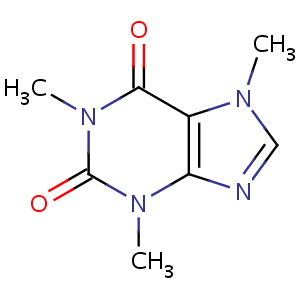
I just found a great article about Caffeine in coffee. The specialist author: Jerry Baldwin is co-founder of Starbucks in Seattle, where he was the first roaster and coffee buyer – he is quick to add that started the company but has nothing to do with it’s current paths. Included in the article are parts from Corby Kummer’s “The Joy of Coffee” book, a very good read about Coffee having connoisseurs like wine and fine foods do which Jerry was also interviewed for.

Here are a few highlights from the article, but more detail can be found in the original post (link below).

We generally estimate caffeine content to average 1% for coffea Arabica and 2% for Robusta (coffea Canephora) by weight. The real issue is the caffeine content of the cultivar, i.e. the species (Arabica or Robusta) and especially the variety of the coffee within the species.

Several studies testing 90 different Arabica cultivars, caffeine content varied between 0.42 and 2.9%.

If your morning cup came from a commercial roaster who included Robusta in the blend, there will be another level of complexity. Caffeine content in these coffees, per one study, varied between 1.16 and 4.0%. A straight 12 oz. cup, using 20 grams of the 4% coffee, probably wouldn’t taste very good, but would definitely provide more buzz: 800 milligrams of caffeine!

As we find with anything… they more you research the more you learn that there is much more than can be learned quickly. A few generalized thoughts:

• Arabica averages about half the caffeine as Robusta.
• The cultivar determines the caffeine content.
• Degree of roast has no meaningful effect on caffeine.
• An espresso made from 100% Arabica, on average, has about 70 milligrams of caffeine per shot; a 12 oz. cup of drip coffee made my way in a press pot, using two scoops of coffee per 12-ounce cup — would have 200 milligrams.

See the full discussion “Appreciating Coffee Like Wine” by Jerry Baldwin here…

Caffeine

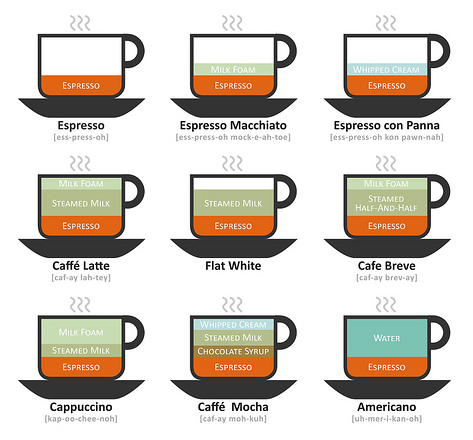
A Diagram of your favorite Coffee and Espresso Drinks

Lokesh Dhakar, a designer, was looking for a visual representation of what makes up the many different types of espresso drinks.

Unable to find a single source for the information, he pulled together the data from many sources like coffee specialists, drink houses and wikipedia to produce a very handy visual chart. Below is a quick screen capture with a link to his higher resolution version on Flickr. As you can see, he has covered a nice variety from what we think of as a regular espresso through to drinks containing many ingredients – 9 in all.

coffee drink diagram

Lokesh’s site is here as well…

Cappuccino versus Latte – the difference

Cappuccino: Equal parts of Steamed Milk and Espresso. The milk will be more bubblier in the Cappuccino and may take up a third of the drink.

Latte: Milk and Espresso, usually with more Espresso than Milk… the milk is treated like an additive so there is less of it and wont have the foam on top than the Cappuccino.

When trying to remember which is which – there are three ‘c’s in Cappuccino. Just like the parts of the drink; foam, milk and espresso. Latte is actually short of Caffe Latte (means coffee with milk in Italian)

20127620

Judging Lattes and Espresso drinks

I just found that there was a Latte and Espresso drink competition recently in Dallas. A local lady, Teresa Gubbins, was chosen to help judge the cups of dark joy. She wrote a nice post about her adventure. After reading the fun she had, I researched and found there was another major global competition for Baristas. I need to see if next year’s competition will be a possible vacation spot.

For the local event: Sherri and Danny Johns of Portland-based (my old stomping grounds) WholeCup Coffee conduct barista competitions at trade shows around the world. On Sunday, June 28th, they hosted the Ultimate Barista Challenge competition at the Southwest Foodservice Expo, a three-day trade show for the restaurant biz at the Dallas Convention Center which continued through Monday and Tuesday.

Sunday’s competition drew six baristas from Texas and beyond who prepared three espresso-based drinks: 1. macchiato, 2. latte, and 3. specialty drink creation. Danny emceed and Sherri supervised the judging, with a panel that included coffee experts Heather and Jay Kurima, and the author. Catch her whole adventure here…

For the big global competition, you can go to World Barista Championship who just finished their 2009 event in Atlanta. 52 Baristas competed for the award, with Gwilym Davies from the United Kingdom. I’m not sure if that plays into next year’s event, but it will be in the United Kingdom.